
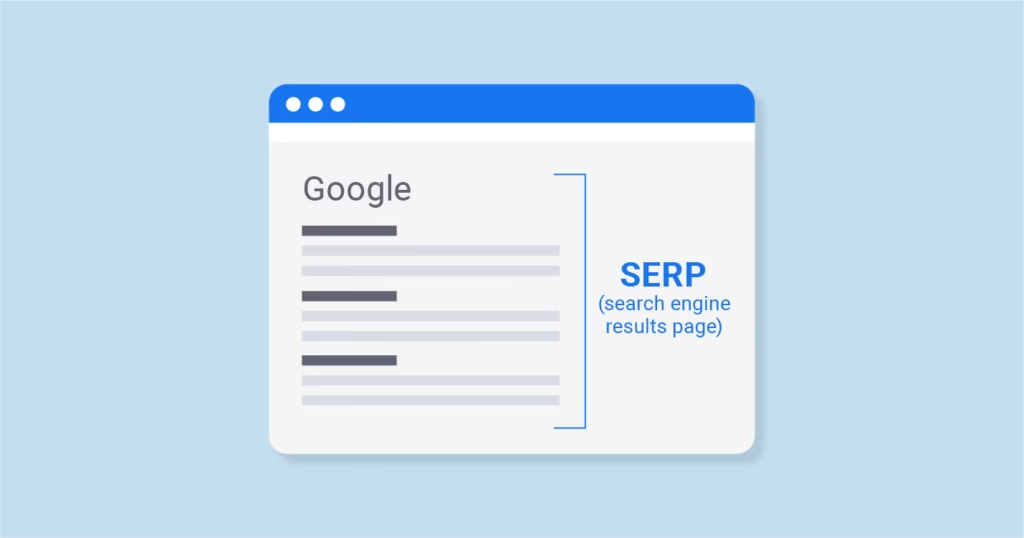
If you have ever searched for something on Google, Bing, or another search engine, you have seen a SERP. The term SERP stands for Search Engine Results Page. It is the page displayed by a search engine after a person enters a search query.
A SERP can contain much more than traditional blue website links. Modern search results may include advertisements, featured snippets, images, videos, maps, shopping results, news, related questions, local business listings, and other search features.
Understanding what is a SERP is important for anyone working in SEO, digital marketing, content marketing, website development, or online business. Search engine optimization is largely about improving a website’s visibility within relevant SERPs.
What Is a SERP?
A SERP, or Search Engine Results Page, is the results page shown by a search engine in response to a user’s search query.
For example, if someone searches for “best laptops for students,” the search engine analyzes the query and displays a collection of results that it believes are useful.
The results may include organic webpages, sponsored advertisements, product listings, videos, reviews, images, and other features.
The exact appearance of a SERP changes depending on the search query, location, device, language, search history, and available search features.
| Term | Meaning |
|---|---|
| SERP | Search Engine Results Page |
| Search query | Words entered into a search engine |
| Organic result | Unpaid search result |
| Paid result | Advertisement displayed in search |
| Ranking | Position of a result in search |
| Search feature | Special result format on a SERP |
How Does a SERP Work?
When someone enters a query into a search engine, the search engine attempts to identify the most relevant information available.
Search engines use automated systems to discover webpages, analyze content, understand relationships between information, and determine which results may be useful for a particular search.
The process generally involves crawling, indexing and ranking.
Crawling allows search engines to discover content. Indexing involves storing and understanding information about webpages. Ranking determines which eligible results should appear for a particular query.
The final results are displayed on the SERP.
Google explains that its automated systems organize information from webpages and other sources to provide relevant results for searches. (developers.google.com)
What Does SERP Stand For?
SERP stands for Search Engine Results Page.
The abbreviation is widely used in SEO and digital marketing.
For example, SEO professionals commonly use phrases such as:
- SERP ranking
- SERP features
- SERP analysis
- SERP competition
- SERP visibility
- SERP tracking
- SERP position
Understanding these terms is useful when analyzing how a website performs in search engines.
What Does a SERP Look Like?
There is no single standard SERP layout.
A SERP can look different depending on what the user searches for.
A search for a local restaurant may display a map and local businesses. A search for a product may display shopping results. A search for a breaking news topic may show news stories. A question may trigger a featured snippet or other direct-answer result.
A typical Google SERP may contain:
- Paid advertisements
- Organic search results
- Featured snippets
- People Also Ask
- Images
- Videos
- Local results
- News results
- Shopping results
- Related searches
Not every SERP contains all of these features.
Organic Search Results
Organic results are unpaid listings that search engines display because their systems determine that they are relevant to the search.
An organic result commonly contains a title, URL or site identification, and a description or snippet.
For example, a search for “what is technical SEO” could return an SEO guide as an organic result.
Organic visibility is one of the primary goals of SEO.
Unlike paid advertising, businesses do not directly pay a search engine every time someone clicks an organic listing.
However, achieving strong organic rankings generally requires quality content, technical optimization, authority, relevance, and a good user experience.
Paid Search Results
Paid search results are advertisements that appear on search engine results pages.
Businesses can use advertising platforms such as Google Ads to bid on eligible search terms and display advertisements to potential customers.
Paid results are typically labeled as advertisements or sponsored results.
| Organic Search | Paid Search |
|---|---|
| Usually unpaid clicks | Advertiser pays for clicks or other actions |
| SEO is used to improve visibility | Advertising platforms are used |
| Can provide long-term visibility | Visibility can stop when campaigns stop |
| Ranking depends on search systems | Placement depends on advertising systems |
A business can use both SEO and paid search as part of a broader search marketing strategy.
What Are SERP Features?
SERP features are special elements that appear on search engine results pages beyond traditional organic listings.
They are designed to help users find information more efficiently.
Some SERP features can provide an answer directly on the results page, while others help users discover different types of content.
Common SERP features include:
| SERP Feature | Purpose |
|---|---|
| Featured snippet | Highlights an answer from a webpage |
| People Also Ask | Shows related questions |
| Local pack | Displays local businesses |
| Image results | Shows relevant images |
| Video results | Displays video content |
| News results | Shows news articles |
| Shopping results | Displays products |
| Knowledge panel | Provides information about an entity |
| Related searches | Shows related queries |
The presence of a particular feature depends on the query and search context.
Featured Snippets
A featured snippet is a search result format that may display an answer prominently near the top of a Google results page.
It can appear as a paragraph, list, table, or another format.
For example, a search for “what is a meta description” may show a short definition from a webpage before the traditional organic results.
Featured snippets can increase visibility because they occupy prominent space within the SERP.
However, there is no guaranteed method for obtaining a featured snippet.
The best approach is to create clear, accurate content that directly answers relevant questions.
People Also Ask
The People Also Ask feature displays related questions that users may want to explore.
For example, someone searching for “SEO” may see questions such as:
- What does SEO stand for?
- How does SEO work?
- Why is SEO important?
- How long does SEO take?
This feature can provide useful information for SEO professionals conducting keyword and content research.
Questions appearing in People Also Ask can also help businesses identify topics that may deserve coverage on their websites.
Local SERPs
Local SERPs appear when search engines determine that a query has local intent.
For example, someone searching for “digital marketing agency near me” may see local businesses, maps, addresses, reviews, opening hours, and other location-related information.
Local SEO focuses on improving visibility for these types of searches.
Local SERPs are particularly important for businesses that serve customers in specific geographic areas.
Image SERPs
Image searches produce results dominated by visual content.
Search engines may display images from websites, product pages, publishers, social platforms, and other sources.
For businesses with visually important products or services, image search can provide an additional source of website discovery.
Image SEO can involve:
- Descriptive filenames
- Relevant surrounding content
- Appropriate image formats
- Useful alt text
- Fast loading
- Mobile-friendly implementation
- High-quality original images
Images should be relevant and useful rather than added solely for search engine manipulation.
Video SERPs
Video content can appear directly within search results.
YouTube videos are particularly visible for many informational and how-to searches, although search engines can surface video content from other websites and platforms as well.
Video SEO can include optimizing titles, descriptions, chapters, thumbnails, transcripts, structured data where appropriate, and the surrounding webpage.
Video results can be especially useful for tutorials, product demonstrations, software walkthroughs and educational content.
Shopping SERPs
Shopping-related searches can trigger product results.
For example, someone searching for “wireless headphones” may see product images, prices, merchants, ratings and other shopping information.
For ecommerce businesses, visibility in shopping search results can be an important part of an organic and paid search strategy.
Product information should be accurate and consistent across relevant feeds and webpages.
News SERPs
News-related searches can display articles from publishers and other news sources.
These results can change rapidly because search engines need to surface fresh information for queries where recency matters.
Businesses that publish newsworthy information, original research, announcements, or industry reports may have opportunities to appear in relevant news search features.
Knowledge Panels
Knowledge panels are information boxes that can appear for searches involving recognized people, organizations, places, brands, and other entities.
They may contain information collected from multiple sources.
For businesses, a strong and consistent online presence can help search engines understand the organization and its identity.
However, businesses should not assume that creating a particular webpage automatically guarantees a knowledge panel.
Why SERPs Matter for SEO
SERPs are central to SEO because they determine how users discover websites through search engines.
Ranking near the top of a relevant SERP can increase visibility and potentially generate more organic clicks.
However, rankings alone do not guarantee business results.
A webpage may rank well but receive relatively few clicks if the search result does not match user intent or if competing SERP features attract attention.
This is why modern SEO should consider both rankings and the overall search experience.
SERP Ranking
SERP ranking refers to the position of a webpage or other result within a search engine results page.
For example, if a webpage appears as the first traditional organic result, an SEO professional may describe it as ranking in position one.
Rankings can vary depending on factors such as:
- Search query
- Location
- Device
- Language
- Search context
- Competition
- Search engine systems
- Content relevance
Therefore, a website may not have one universal ranking for every user.
What Is SERP Analysis?
SERP analysis is the process of examining the search results for a particular keyword or query.
SEO professionals use SERP analysis to understand what search engines currently show for a topic and what types of pages are competing.
A SERP analysis can examine:
- Search intent
- Ranking pages
- Content formats
- SERP features
- Competitors
- Content depth
- Page titles
- Search result descriptions
- Backlink profiles
- Internal linking
- User questions
This information can help determine what type of content should be created or improved.
How to Perform a SERP Analysis
Start by searching the target keyword in the search engine you are optimizing for.
Review the first page carefully rather than looking only at the first result.
Identify the dominant search intent.
For example, if most results are detailed guides, a short product page may struggle to satisfy the search intent.
Then examine the SERP features.
If the results include videos, images, featured snippets, People Also Ask questions and product listings, the keyword may require a broader content strategy.
Finally, study the competing pages and identify opportunities to provide something more useful, clearer, more original, or more complete.
SERP and Search Intent
Search intent is one of the most important concepts when analyzing a SERP.
The search engine results themselves provide clues about what users want.
For example, if a query consistently produces comparison pages, the search intent is likely commercial investigation.
If the results mostly contain tutorials, the intent may be informational.
| Search Intent | Typical SERP Results |
|---|---|
| Informational | Guides, articles, videos |
| Navigational | Brand or specific website |
| Commercial | Reviews, comparisons, buying guides |
| Transactional | Product and service pages |
| Local | Maps and local businesses |
SEO content should be designed around the actual intent shown by the SERP.
SERP Position vs Click-Through Rate
SERP position and click-through rate are related but different.
SERP position describes where a result appears.
Click-through rate, or CTR, measures how frequently users click a result after seeing it.
A high ranking can improve visibility, but title relevance, search intent, branding, snippets, SERP features and competition can all influence clicks.
A good SEO strategy therefore focuses on earning relevant visibility and creating search results that accurately communicate the value of the page.
How to Improve SERP Visibility
Businesses can improve their search visibility by creating useful content and maintaining a technically sound website.
Important areas include:
- Targeting relevant search intent
- Creating original and helpful content
- Improving page titles
- Writing useful meta descriptions
- Building logical internal links
- Improving website architecture
- Fixing indexing problems
- Improving page experience
- Earning relevant backlinks
- Keeping important information updated
- Using appropriate structured data
- Creating content that demonstrates genuine expertise
Google’s SEO documentation emphasizes making content accessible, useful and understandable while ensuring search engines can crawl and index the website effectively. (developers.google.com)
SERP Tools
SEO professionals can use various tools to analyze SERPs and track search performance.
Google Search Console is particularly useful for website owners because it provides information about search performance, queries, pages, impressions and clicks. (developers.google.com)
Other SEO platforms can provide keyword tracking, competitor analysis, SERP history and additional research capabilities.
| Tool Type | Common Use |
|---|---|
| Google Search Console | Search performance |
| Keyword trackers | Ranking monitoring |
| SEO platforms | Competitor research |
| Analytics tools | Organic traffic analysis |
| Search engines | Manual SERP analysis |
Tools should support strategic decision-making rather than replace actual analysis.
SERP Changes Over Time
SERPs are not static.
Search engines continually change how information is displayed and how users interact with results.
A keyword that previously displayed ten traditional blue links may later include images, videos, questions, local results, products or other features.
This means SEO professionals should periodically review important SERPs rather than relying on an old snapshot.
Changes in search behavior, technology, competition and search engine systems can all influence SERP layouts.
Why SERP Features Matter for Businesses
SERP features can create additional opportunities beyond traditional organic rankings.
For example, a business may compete for:
- Traditional organic results
- Featured snippets
- Image visibility
- Video results
- Local results
- Product results
- News visibility
- Related questions
The best opportunity depends on the type of business and search query.
A SaaS company may benefit from product pages, comparison content and videos, while a local service business may prioritize local search visibility.
SERP Best Practices
Businesses should approach SERP optimization from the user’s perspective.
The objective should be to provide the best answer or resource for the search rather than attempting to manipulate every available SERP feature.
Good practices include creating original content, matching search intent, keeping information accurate, improving technical accessibility, using descriptive titles, providing clear answers, and maintaining a trustworthy website.
Google’s guidance recommends creating helpful, reliable, people-first content rather than content created primarily to manipulate search rankings. (developers.google.com)
Final Thoughts
A SERP, or Search Engine Results Page, is the page displayed by a search engine after a user enters a search query.
Modern SERPs can contain much more than traditional organic listings. Featured snippets, People Also Ask, images, videos, local results, shopping listings, news and knowledge panels can all appear depending on the query.
For SEO professionals and website owners, understanding SERPs is essential because search visibility depends on how content competes within these changing result pages.
The most effective approach is to study the SERP before creating content, understand the searcher’s intent, analyze competing results, and build a page that provides genuine value.
Rather than focusing exclusively on achieving a particular ranking position, businesses should aim to become the most useful and relevant result for the searches that matter to their audience.
What does SERP stand for?
SERP stands for Search Engine Results Page. It is the page displayed by a search engine after a user enters a search query.
What is an example of a SERP?
If someone searches Google for “best SEO tools,” the page displaying advertisements, organic results, comparison pages, videos, questions and other search features is a SERP.
Why are SERPs important for SEO?
SERPs are important because they determine how webpages and other content are presented to people searching for information. Improving visibility within relevant SERPs can increase organic traffic and potential customers.
What are SERP features?
SERP features are special search-result elements beyond traditional organic listings. Examples include featured snippets, People Also Ask, image results, video results, local packs, shopping results and knowledge panels.
How can I improve my website’s SERP visibility?
You can improve SERP visibility by creating helpful content that matches search intent, improving technical SEO, optimizing important pages, developing internal links, earning relevant authority and ensuring search engines can crawl and understand your website.
Pingback: CEO SEO: Understanding the Difference Between CEO and SEO -